Friday, Dec. 5

Our time in Tokyo was closing in on us with only a few days left of exploring. We couldn't believe how fast the trip was going by! Today we would be visiting Namco Bandai Games in Shinagawa, which would be the last company visit for most of us. A few other students were scheduled to see a game company in Kutsugawa called Assemblent the following Wednesday.

Before we set off for Namco Bandai we stopped at a small outdoor shopping area for some lunch. We were surprised when we found a 100 yen store and decided to fill up on snacks instead. The tiny store had so much cool stuff in it! I bought myself two keychains of little yarn figures that resembled the character Sackboy from Little Big Planet. I also found a bag of my favorite snack that tasted better than cheetos. Overall it was quite a successful shopping excursion.


Left to Right: Inside Namco Bandai's impressive building, Outside view of headquarters,
Inside view of wall waterfall and pathway over water

As soon as we arrived at Namco Bandai's headquarters we were impressed by the modern architecture of the building. The inside was spacious with a high vaulted ceiling and large windows to let in tons of natural light. They also had an inside waterfall flowing over a stone wall and a pathway that walked over the shallow water connecting beneath it.

Two English speaking represenatives greeted us and led us into an auditorium deemed the "Fun Theater" by an outside plaque. Then a woman got up on stage to give us an overiew of what we would see during the visit and explain the company history and job specialities. She finished her presentation by showing us a video of Namco's latest games. The video featured highlights from Tekken 6, Innocent Aces, Trusty Bell, Tales of Vesperia, Live for You, and Soul Caliber IV. I was especially interested in the additions that were made to Tekken 6, which allow players to customize their fighters. It seems like personalization and customization are features that Japanese developers leave out of most of their games whereas in America games are often filled with options to change body size, hair color, or a character's background information.

During the next part of the tour we were broken into two groups; one that would visit the sound room and another that would try out the arcade games in the main lobby. My group was taken to the arcade section first where the representatives set us up to play in teams on the Gundam Pods. For this game you would sit inside a pod and control a robot character while listening to teammates through a headset. I don't frequent arcades much so it was a new experience for me to try out the controls inside the pod. The screen inside was almost a 180 view since it wrapped around the sides of the pod, making the gameplay even more immersive. After I got a hang of the controls I was really having a lot of fun playing the game.
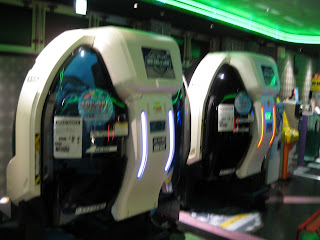
Gundam Pods!

Now it was time for our groups to alternate and my group headed up to the sound room. As we walked through different sections of workstations the reps were saying that teams (ie sound or IT/networking) were placed in their own rooms so that specialists within each team can collaborate with others in the same field.

Once we made it to the sound room we were introduced to an sound guy that had worked on the sounds for Soul Caliber IV. First we watched a video of the game with the final sound in it and then we saw a video about how they created the sounds. It was cool to see the foley artists making walking sounds (in a box of sand) for Yoda while the video of the game played in the background. We had a short Q&A with the sound guy and learned that Lucas Arts had given them the sound of the light saber for the game, but that they had made their own to better match the actions. We also found out that only 7 main employees worked on all of the sound for Soul Caliber IV, which is surprising because I would have expected the sound team to be larger than that.

We regrouped and took a car ride over to Namco's motion capture studio. The building was really spacious inside and we even got to see some actors practicing in some motion capture suits. Two motion capture guys came over to answer some questions as well. They said that the building was big enough for most of the action they needed to capture and that they make all of their own props there too.
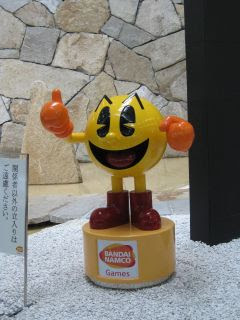
Cute Statue in Namco's main lobby

For the last part of the tour we entered back into the auditorium for a Q&A session. The two English speaking representatives, one specializing in strategic planning and the other in localization, answered some questions about team structure. We also got to meet a few developers from the company. Someone asked a question about the origination of the concept behind Katamari Damacy. The developer told us that it was actually a product made by students from a past school program within the company.

Overall I think we learned a great deal from our visit to Namco Bandai. We also recieved a folder of information and a cute hand cloth patterned with images from the Taiko drum game. To finish the day off we had our second group dinner at a Karaoke place!
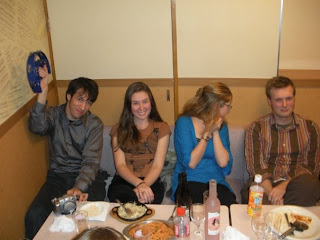
Eating in our Karaoke room

I had to sing at least one song...and it had to be Spice Girls!

Karaoke tv screen

Noriko treated us to Karaoke and everyone was having fun picking out songs and doing duets. We ordered some pizza, chicken wings, and pasta which also hit the spot. And after our 2 hours were up some of us didn't want to leave. It was a great end to a great day.

Saturday, Dec. 6

Today was our free day to explore any parts of Tokyo we wanted to see before leaving for Kyoto the next day. Of course I couldn't pass up the chance to visit Harajuku, which is a major shopping attraction and trendy commercial area frequented by teens and college students. My roomate Lindsay, Lauren, and I decided to spend the whole afternoon there while the rest of our group chose to go back to Akihibara for the day.

Decorations above Takeshita Street entrance


We were ecstatic that we had so much time to explore all the stores we went past on our first walk-through. In fact we couldn't stop saying "Oooohhh I want to go in there...and there!" We spent most of our time along Takeshita street which had various clothing, jewelry, and odds and ends kind of shops. We also found a big 100 yen store which had 3 or 4 floors.

Lauren and Lindsay noticed that many of the girls passing by were wearing these shorts with wooly hemlines and wool lining around the back pockets. It wasn't hard to find them in the stores either, as many of the storefronts had the shorts displayed on outside racks. I was really surprised the fad continued during the winter, but I guess the warmer temperatures and popularity of leggings made up for it. Lauren liked them so much she ended up buying a pair.

Cool outdoor clothing store display

Keychains and...frog coin purses?!?

Besides its hodge-podge of shopping places Harajuku is also well known for cos-play. We saw a couple of girls go by in lolita costumes, but nothing fancy or crazy. We passed by a few costume stores as well and went into one of them to see what kind of outfits they had available. I noticed some maid ensembles and fancy kimono costumes. The women employees in the stores were even dressed up, wearing layer upon layer of blouses and skirts. We definitely got a sense of the fashion trends in Japan throughout the day.

Display outside Cos-play store

The time flew by but before we left Lindsay and I made some purchases. Lindsay bought a cool long sleeve shirt with the Harajuku mascot on it in Japanese lettering (which Noriko later told us meant "Pretty Pig") and I bought a set of leather wristbands, skirt, and cute pink and black leggings. So by the end of our visit we each had a little piece of Harajuku style to take back with us!

We met up with the rest of the group and took the train back to the hotel to drop our shopping bags off. Then Lauren, Lindsay, Rich and I went back to our favorite Italian place for our last dinner in Shinjuku. I was so hungry that this time I ordered my own pizza and finished it all.

Outside of Italian restaurant in Shinjuku

We made one more stop for the night to try out some Pachinko game machines. Rich had tried out the machines the night before and he showed us how it worked. The machine we played on had an underwater fish theme and people all around us had buckets full of these tiny metal balls. We weren't supposed to take pictures inside, but this was something we felt needed capturing. What a great night!


Left to Right: Pachinko screen, Looking down an aisle of Pachinko players

Sunday, Dec. 7

The first half of our day consisted of traveling to Kyoto. We checked out of Keio Plaza hotel, saying goodbye to our favorite breakfast place and comfy rooms. We had only been staying there for a week but we had become really accustomed to the area.

Decorations inside Keio Plaza's lobby

An upside of the trip was the chance to ride on a Shinkansen, better known as the bullet train. We took some local trains to Shinagawa and then transferred onto the bullet train there. I was surprised to see a man smoking a cigar inside one of the trains. On the pavement there were also markings as to whether a train car allowed smoking or not.

The inside of the bullet train was extremely clean and comfortable. The seating arrangements actually reminded me of being in a plane and the ride was smoother than riding on the Metra or El. Altogether it took about 2 hours to get to Kyoto, where we met up with some of Noriko's friends.

Our group inside the bullet train


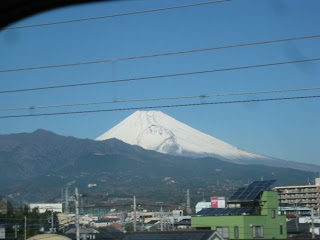
Someone caught a nice photo of Mt. Fuji out the window

Noriko's colleagues were friendly and curious about our experiences in Tokyo. However, they could also tell that we were hungry from our morning trip. They took us to a local sushi restaurant and made a nice gesture by paying for all our meals. It was a filling lunch, as each of us were presented with our own plate of assorted pieces of fish and california rolls. We also got a small bowl of soup on the side. My favorite pieces had to be the salmon and the egg. The salmon didn't have a strong fishy taste as some of the others and the egg seemed to have a sweet flavor.


Beautifully presented plate of sushi

Now that our stomachs were full it was time for the much anticipated event of the day: a Taiko drum lesson. Noriko and her friends led us to our destination. It was close enough for us to walk and I caught some pictures of houses in the neighborhood along the way. The layout of the buildings reminded me of Germany. The housing was tightly packed together with lots of hidden gateways and gardens, and of course the architecture was lovely. I can't get enough of the eave-lined rooftops.


Left to Right: Front of a neighborhood house, Side gateway

We ended up at a school courtyard where we were greeted by students in a high window waving down at us. We took our shoes off inside and went up a few floors to the room where the students and teachers were waiting for us. We had no idea we'd be visiting a school to get a lesson, but I think it was the best place for us to experience it.

Some introductions were made by the teachers and they seemed very excited that we had come to see them. They explained that a few different groups of students had come to show us some of the traditional instruments of Japan. The first group of students, along with their teacher, played us some songs on a stringed instrument called a Koto. Their last song was Jingle bells, to get us into the Christmas spirit!


Left to Right: Students playing Koto, Group playing Taiko drums


The second group of students (3rd - 4th grades) brought out some Taiko drums and played a round of songs. For each one they seemed to have different positions, either placing the drum sideways or laying it upright and playing on top of it. Their finale song was most impressive, with the students playing on top of the drums and adding in details by twirling the sticks in the air before bringing them back down into the beat of other drums.

The last group to present was an advanced trio of girls which had been playing for 10 years. The girls played songs in different positions and you could tell by their technique that not only were they more experienced but they were having a lot of fun. In one of their songs one of the girls had a Taiko drum strapped around her shoulders and was playing on the front and back of it. It was amazing to see these traditional instruments played and performed by such enthusiastic students. We were also surprised to learn that the girls usually played with bigger groups of 3 guys and 3 girls. The beating of the drums was already so loud and impressive we couldn't imagine what a bigger group would sound like.


Left to Right: Advanced student playing Taiko, Trio playing in rhythm


Left to Right: Girl with strapped Taiko, Playing Taiko sideways


Now that we had seen all the students perform it was time for us to get a lesson on the Taiko drums. The teacher stood up and demonstrated how to hold the sticks (gently but firmly and loosen your wrists). Noriko translated for us as the teacher went on to teach us some basic rhythms. We alternated groups so everyone could try and then the teacher gave us a challenge. She wanted us to break into groups and make our own rhythm.

After we had some time to practice our beats each team got up and performed in front of everyone. Although somewhat nerve-racking, everybody got through it and I think we all had fun in the process. Besides, how many people can say they've played the Taiko and created their own rhythm with it?

My group practicing

Next the teacher and my roommate Lindsay performed a song on the Koto. Lindsay had decided to learn the Koto while we were practicing the drums. She did a duet of Jingle Bells with the teacher and played it really well. We had some time left and the teacher went around to practice with anyone that wanted to try out the Koto.

When it was time to go we were sad to leave but also felt so welcomed and honored that the students and teachers had come in on a Sunday when they normally wouldn't. The teacher thanked us for visiting and also left us with a beautiful story about a local river. She said the river got its name from the Milky Way that shone above it and that many people had been inspired by it, creating rhythms to convey the life emanating around it (ie children playing along its shore).

We walked back through the neighborhood and took a train to our hotel called Rhiga Royal. Our rooms were slightly smaller but the lobby and restaurants seemed just as fancy as the first. I also really liked that the rooms had screens covering the windows, which was something traditional we didn't see in Tokyo.

Rhiga Royal hotel room with Shoji screens

Lastly we got a quick bite to eat at a tempure restaurant inside the train station. We needed our energy and rest for the next day, when we'd be seeing some local temples.

**Just as a note you can hear a song featuring Taiko drums on the 3rd track of the music player on this page (under "Japanese Mix" at the top right)
Monday, Dec. 8
For breakfast we tried out the Corbeille Buffet in our hotel. It was similar to the breakfast place we frequented in Tokyo, with potato salad, cereals, and bacon/ham dishes. However, they did have some unique yogurt I've never seen before: Aloe Vera flavor. I was surprised how refreshing it tasted and hope I can find some when we get back to the states.

Kyoto gave us a chance to see the more traditional side of Japanese culture. Although we did see some shrines in Tokyo, today we were on route to visit some larger temples. We took a chartered bus, which was a nice break from the trains and walking, to our first stop at Kiyomizu temple. Just some quick history: Kiyomizu means pure water and the Buddhist temple dates back to the Heian period in 798.


Left to Right: Walking up below Kiyomizu's first gate,
Fortune rack, Tiers of a pagoda


We had to walk up a somewhat steep street, lined with little shops, to get to the entrance of the temple. Even then, its buildings were spread out in tiers across the mountainous landscape. There were stairways leading up and down to different areas with worship sites or lookout points onto the city below. The main sanctuary was dedicated to the bodhisattva Kannon, or Avalokitesvara, the deity of compassion and mercy.

The decorations and architecture were breathtaking. Every time I turned around I found a statue or pagoda that I had to have a picture of. For instance, there was an intrictate sculpture of a dragon adorning a water purification fountain before the entrance to one of the shrines. I also noticed that there were lots of little stands with fortunes or talismans.


Left to Right: Fancy dragon water purification fountain,
Interesting stand with statue

View from far side of temple looking onto city below

Before leaving we had some time to explore the shops along the street. I had a really peaceful feeling walking through the spaces of the temple and I wanted to get something to remember that by. I was hoping to get a representation of a Budhha or bodhisattva, but the shop that I found with small wooden versions were selling for 10,000 yen ($100). However, I ended up with the next best thing by accident.

In the same shop I purchased some beaded bracelets, which I figured were for protection or healing. Later when I took them out of the bag I noticed the center bead had a hole in it. Curiously I put it up to my eye and felt like I was looking through a kaleidascope. The small bead actually held an image of a bodhisattva inside, which could be viewed when you held it up to the light. What a surprise!


Left to Right: Outside a street shop below Kiyomizu,
Another shop full of candies

We piled back on the bus and drove over to see Sanjusangen-do, another Buddhist temple. The outside of the main temple hall seemed plain at first but we were amazed to see what was held inside. We took off our shoes and then entered the main hall. Along the wall was a description explaining the temple's dedication to Kannon or the Thousand Armed Kannon. Then we turned the corner to see a line of statues, row upon row, proceeding down the entire length of the hall.

To be exact there were 1,000 standing statues of Kannon with a larger seated statue of Kannon in the center of the hall. I was in awe the entire time, walking past the weather-worn statues, thinking about their history dating backing to the 12th-13th centuries. The pure volume of space that the statues were taking up was stupefying enough. I was also excited to see guardian statues situated in front of the army of Kannons. There were 28 of these guardian statues and each of them had signs with descriptions. You can visit http://www.taleofgenji.org/sanjusangendo.html to get a better idea of the statues inside (as we couldn't take photos).

Since I had studied Buddhist art I paid special attention to the gestures and expressions on the standing Kannon statues. I thought it was interesting that some of their expressions and facial structures were different, whereas their hands seemed to be positioned in the same greeting mudra. The way the statues were carved, having incised or excised features, varied from statue to statue. Later I read through the temple's brochure and found that only 124 of the standing Kannons were made in the 12th century while the other 876 were completed in the 13th century. This might account for the variations I saw in some of the statues.


Left to Right: Side of Sanjussangen-do's main hall,
Fortune rack in front of hall, Looking towards temple entrance

After walking past the long line of statues the opposite side of the hall was filled with more history about the temple. There were glass cases with artifacts in them, including one detailing a fire and restoration the temple had undergone. They also had a section on archery competitions with some of the original bow and arrows (which were huge!). The competitions had been held on the grounds since the Edo period, between the 17th-19th centuries.

Now we were heading to the last temple visit of the day. We arrived at Rokuon-ji or the Golden Pavilion and went through the entrance gates to get our tickets. The tickets themselves were very artistic, with red and black lettering printed on a long strip of paper. Once through the gates we walked along a dirt path and came up to an opening onto Kyoko-chi pond. The view was magnificent with the Golden Pavilion and trees reflecting off of the still water. I can see how this place was a refuge for peace and meditation.

I found it interesting that the temple actually blends 3 different styles of architecture. The first floor is built in a palace style, the second according to the style of a samurai house, and the third in Zen temple style. Furthermore, the islands and stones scattered throughout the temple grounds represent parts of the Buddhist creation story. It was amazing to see first hand so many Buddhist sites that I had only read about in books before.

Golden Pavilion over-looking the pond of Kyoko-chi

We continued along the path passing by some smaller buildings and other isolated ponds. The main attraction was of course the Golden Pavilion, which could be seen at different angles from the pathway. I also thought it funny that the many openings on the path were occupied by gift stands. They were selling tiny healing or protection bags; some decorated with Hello Kitty icons. We had to have passed 4 or 5 of these gift stores by the time we reached the exit.

The final stop of the day was to Toei Uzumasa Movie Land. Described as a theme park, Movie Land was inhabited by exhibits of older movies/shows and actors dressed up in costume. Apparently real filming was even completed there in a separate acting area. Looking through the map on the brochure it seemed like there was a lot to explore.

Front of one of Movie Land's attractions

However, once inside and after some walking we found the park to be fairly empty. The fact that it was a Monday afternoon could account for this, but overall we found ourselves passing up gift shop after gift shop in hopes of finding a meaningful exhibit.

Eventually we made it into a large complex that had a Super Hero Land. We waltzed through sections of popular life size character rooms and props. The only ones that I recognized were the Power Rangers. They also had some rooms dedicated to photos of actors dressed up as samurai or geishas.


Left to Right: Power Ranger display, Signed photos of Movie Land actors

We had lunch at the park's Star's Cafe. I ordered fried pork on a stick with a side of salad. It was delicious (there were bits of cabbage mixed in with the pork). We left Movie Land and spent the rest of the evening at the hotel. The rest of our group was ancy to check out the arcades around the area. Later we got dinner at an Italian place inside the train station. If I wasn't already full from lunch I was definitely full after dinner. I ordered a dish of eggplant with cheesy gratin and it was almost better than what I've gotten back home. Yum!

Tuesday, Dec. 9

We had the morning free so I spent some time checking emails and catching up on sleep. Meanwhile the rest of our group visited the birthplace of Nintendo (since we weren't allowed inside). Then later on in the afternoon we all met up at the train station to set off for the activity (my favorite) of the day: kimono wearing!

I was so excited that we would get to learn how to dress in traditional kimonos. Ever since I saw the movie Memoirs of a Geisha I've been interested in the history of eastern cultures. I was especially drawn to the artistic nature of geisha culture and the skills and trades that are part of their lifestyle. To be able to witness and take part in the art of kimono wearing was a dream come true for me.

We arrived at Kyoto Cultural Center close to Ginkakuji for our lesson. We were surprised that the business was inside a neighborhood house (similar to what we encountered on the way to our Taiko lesson). Once inside we took off our shoes and then the girls were ushered upstairs while the guys waited on the lower level.

Upstairs we were greeted by some older ladies who then shut the door and told us to start undressing. It was a little unsettling at first but the women were very quick about getting the layers underneath of our kimono on, so we didn't have to stand around in our underwear! The under-layers consisted of a skirt and top made of thinner cloth. We also took off our socks and replaced them with some soft ninja-turtle looking slip ons, which were super comfortable.

Next the women took a tie and wound it around our waist to keep the layers in place. Then we picked out the material for the main part of the kimono. I chose a deep red cloth with flowers. The lady dressing me helped me put it on and then gave me a piece of cardboard to hold on my stomach. Finally she picked a contrasting cloth, called an obi, to wrap around my waist and keep the kimono in place. It was tied in a large bow at the back.


All dressed up after coming down the stairs

After we finished getting dressed we came downstairs to show the guys what they were in for. Since there were so many people in our group the guys had to alternate to use the dressing rooms. Meanwhile we (the girls) started our dance lesson.

There was a separate room that looked like a studio on the first floor. This is where we started learning a traditional Japanese dance called Nihon Buyo. We were given fans and taught how to properly open and close them. We were also taught how to walk, sit down, and stand back up gracefully (which was probably the most difficult). After we had the basics down the teacher began showing us the key movements of the dance.

I think this part was the most fun because each position seemed to have a relation to Japanese culture. There was a move where we had to bring our arm all the way inside the sleeve of the kimono and turn away, looking shy. Another motion consisted of simply turning our head to the left, right, and then look towards the moon. We also took our fans and moved it back and forth towards the ground, in a waterfall motion, which the teacher explained was simulating cherry blossoms.


Learning traditional Japanese dance

The first group of guys finally came down and began to learn the dance. When everyone got a chance to go through the lesson the girls joined the guys for a last performance. By now however, most of us had forgotten the moves! Nevertheless we pulled it off well and had an awesome time.
Now it was time for the teacher to perform more complicated songs for us. She completed two dances with her colleague explaining the stories behind them. I enjoyed watching her performances as she embodied such gracefulness while the traditional music played in the background.


Left to Right: Guys learning how to hold their fans, Our trio of apprentice geishas

We thanked the women for everything and took a group picture before changing out of our kimonos. I was almost sad to take it off but I knew I would have pictures to remember it all. It was a wonderful experience all around!

Nice group picture with our dance instructor

The end of the day was scheduled for our third and last group dinner. Noriko had reserved a place for us at a Shabu-Shabu restaurant and we took some cabs back to the city closer to the restaurant. I wasn't sure what to expect for dinner since I heard it was similar to a fondue place.

At the restaurant we were taken into our own room with two long low tables on the ground. We sat down and the waitresses lit a fire beneath two large pots on both ends of the table. The pots were filled with water and once it got boiling we starting adding in our ingredients. We were presented with a dish of vegetables including (from what I could tell) shitake mushrooms, clear noodles, tofu, and some radishes.

Left to Right: Shabu pot, Dish of veggies before we added it to our pot

The waitresses came back with two large plates of meat for each table. Now it was time for the best part of the meal. We picked up the meat with the chopsticks and swished it back and forth in the water for a few seconds, until it was no longer red. Then there were two sauces to dip it in, of which my favorite was the peanut sauce. Mixed with some of the cooked vegetables from the pot we had a full course meal.

Apparently that was not the end of our service though. The waitresses came out once more, this time with plates of noodles. We were told to dump the noodles into our pot and mix it in the broth we had created from the vegetables. Now we had our very own Shabu-Shabu soup! All of the food was really good and if I'm ever in Japan again I'll be sure to stop by one of these restaurants again.